


As agricultural labor shortages increase, production costs rise, and precision farming technologies continue to advance, agriculture is gradually shifting from traditional labor-intensive methods toward automation, digitalization, and intelligent management.
As an important part of smart agriculture, crop protection drones are now widely used for pesticide spraying, foliar fertilization, seed spreading, and farmland monitoring.
Crop protection drones can improve operational efficiency, reduce agricultural costs, minimize chemical waste, and enhance safety in challenging working environments. With continued progress in flight control systems, artificial intelligence, and agricultural data technologies, drones are expected to play an increasingly important role in the future of farming.
What Is a Crop Protection Drone?
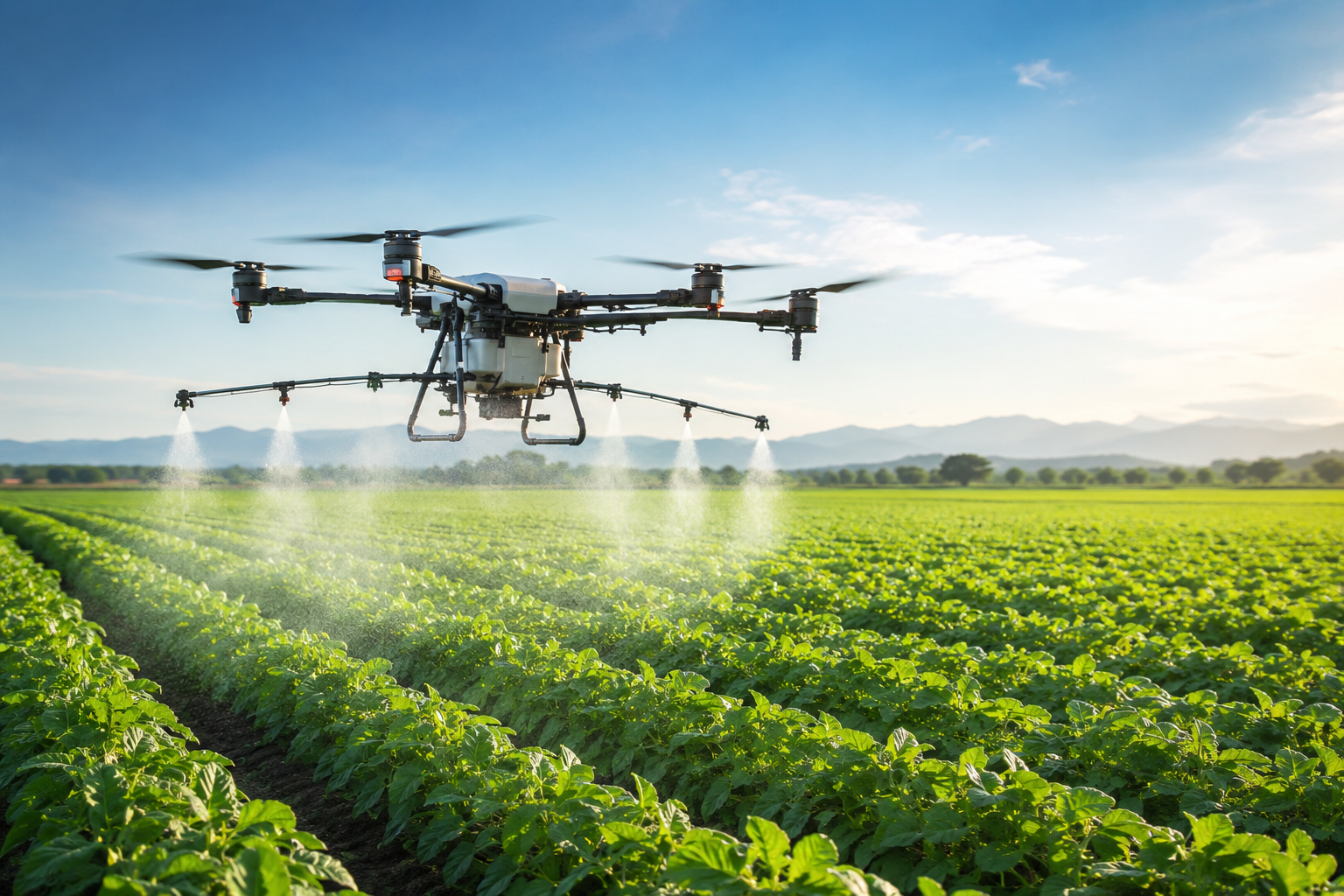
A crop protection drone is an unmanned aerial vehicle specifically designed for agricultural operations. It is typically equipped with a liquid tank, spraying system, intelligent flight controller, and high-precision positioning system.
Crop protection drones can be used for:
- Pesticide and herbicide spraying
- Liquid fertilizer application
- Seed spreading
- Pest and disease control
- Orchard and cash crop management
- Farmland inspection and crop growth monitoring
Compared with manual spraying and large agricultural machinery, crop protection drones are more flexible and less dependent on roads or terrain conditions. They are especially suitable for hills, orchards, rice fields, and large-scale farms.
Major Development Trends in Agricultural Drones
1. Increasingly Automated Operations
Early agricultural drones usually required operators to control the aircraft continuously. Modern crop protection drones can perform automatic route planning, terrain-following flight, breakpoint resume spraying, and automatic return-to-home operations.
Operators only need to define the field boundaries, flight height, speed, and spraying parameters. The drone can then complete the task by following the planned route. This reduces operating difficulty and helps improve spraying consistency.
In the future, agricultural drones will become even less dependent on manual control, enabling full-process automation from mission planning and chemical application to operational reporting.
2. Integration with Precision Agriculture
Precision agriculture focuses on allocating pesticides, fertilizers, and water according to the actual conditions of different areas within a field.
Future crop protection drones will be increasingly integrated with satellite positioning, remote sensing, agricultural sensors, and farm management platforms.
By analyzing crop growth, pest distribution, and soil conditions, drones can perform variable-rate spraying in specific areas. For example, they can increase the application rate in heavily affected areas while reducing it in healthy sections of the field.
This approach helps reduce pesticide and fertilizer consumption while improving the efficiency of agricultural inputs.
3. Artificial Intelligence for Detection and Decision-Making
Artificial intelligence and image recognition technologies are changing how agricultural drones are used.
Drones equipped with high-resolution cameras or multispectral sensors can collect crop images and identify weeds, pests, diseases, water stress, and nutrient deficiencies.
In the future, agricultural drones will not only carry out spraying tasks but also support field analysis and agricultural decision-making. Based on the collected data, AI systems will be able to generate operational recommendations, helping farmers identify problems earlier and take timely action.
4. Improved Payload, Flight Time, and Efficiency
Flight time and payload capacity are important factors that affect the productivity of agricultural drones.
With continuous improvements in batteries, motors, aircraft materials, and energy technologies, crop protection drones will be able to carry larger tanks, fly for longer periods, and cover more farmland during each operation.
Supporting technologies such as fast battery replacement, automatic tank refilling, and automated takeoff and landing stations are also developing rapidly. For large farms, coordinated operations involving multiple drones may become an important way to increase productivity.
5. Growth of Agricultural Drone Service Models
Purchasing and maintaining agricultural drones may require a significant initial investment, particularly for small and medium-sized farms. As a result, professional drone spraying service models are becoming increasingly popular.
Farmers can purchase services according to their field size and operational requirements without having to invest in equipment, operator training, or maintenance.
This model lowers the barriers to using agricultural drones and can help expand their adoption across more regions and farming operations.
How Crop Protection Drones Affect Agricultural Development
Improving Agricultural Efficiency
Crop protection drones can quickly complete spraying operations over large areas, reducing the time and labor required for traditional backpack spraying.
In pest and disease control, where timing is especially important, drones allow farmers to respond quickly and help reduce crop losses caused by delayed treatment.
Addressing Agricultural Labor Shortages
Changes in rural labor structures have created labor shortages and increased employment costs in many agricultural regions.
Crop protection drones can take over repetitive and physically demanding spraying tasks, allowing farm workers to focus on field management, equipment maintenance, and production planning.
Reducing Operators’ Exposure to Chemicals
During traditional manual spraying, workers may come into direct contact with pesticides or remain in spraying environments for extended periods.
Drone spraying allows operators to maintain a safer distance from the application area, reducing the risk of direct chemical exposure.
However, operators must still follow local pesticide regulations, observe safety procedures, and wear appropriate protective equipment.
Reducing Chemical Waste and Environmental Impact
Crop protection drones can improve spraying accuracy and consistency by controlling flight height, speed, spray width, and liquid flow rate.
When combined with variable-rate spraying technology, drones can automatically adjust application rates according to actual crop conditions.
More precise spraying can reduce excessive chemical use, lower input costs, and minimize the potential impact of pesticide drift on nearby areas.
Promoting Digital Farm Management
While completing agricultural tasks, drones can record information such as flight routes, operating time, covered area, and chemical consumption.
This information can be uploaded to a farm management platform, helping farmers analyze production costs, evaluate spraying results, and plan future operations.
When connected with weather stations, agricultural sensors, and other farming equipment, drones can become part of a more comprehensive digital farm management system.
Challenges Facing Agricultural Drones
Despite their advantages, crop protection drones still face several challenges.
Different countries and regions have different regulations covering drone flights, pesticide application, and operator qualifications. Users must understand and comply with all applicable local requirements.
Weather and environmental conditions can also affect spraying performance. Wind speed, rain, temperature, power lines, trees, and other obstacles may limit when and where drones can operate.
Equipment costs, maintenance capabilities, operator training, and after-sales support are also important considerations. A reliable training and service system is essential for the safe and long-term use of agricultural drones.
The Future of Crop Protection Drones
In the future, crop protection drones will no longer operate simply as independent spraying machines. They will become important parts of integrated smart farming systems.
A drone may first inspect a field and use cameras and sensors to identify potential problems. An AI-powered system could then analyze the collected data, create a targeted treatment plan, and direct the drone to complete the required operation automatically.
The results could be uploaded to a farm management platform, creating a complete workflow covering monitoring, analysis, decision-making, execution, and evaluation.
As technologies mature and production costs decrease, agricultural drone applications will continue to expand from conventional field crops to orchards, tea plantations, forestry, specialty crops, and other agricultural environments.
Multi-drone coordination, automatic refilling, remote fleet management, and fully autonomous farms are expected to become major directions for future development.
Conclusion
Crop protection drones are transforming traditional agricultural production. They can improve spraying efficiency, address labor shortages, reduce operational risks, and support the development of precision agriculture and digital farm management.
As autonomous flight, artificial intelligence, sensor technologies, and agricultural data platforms become more closely integrated, crop protection drones will be used in increasingly diverse and complex farming environments.
For farms and agricultural service providers seeking to improve productivity, control input costs, and modernize their operations, crop protection drones represent an important and promising agricultural technology.