

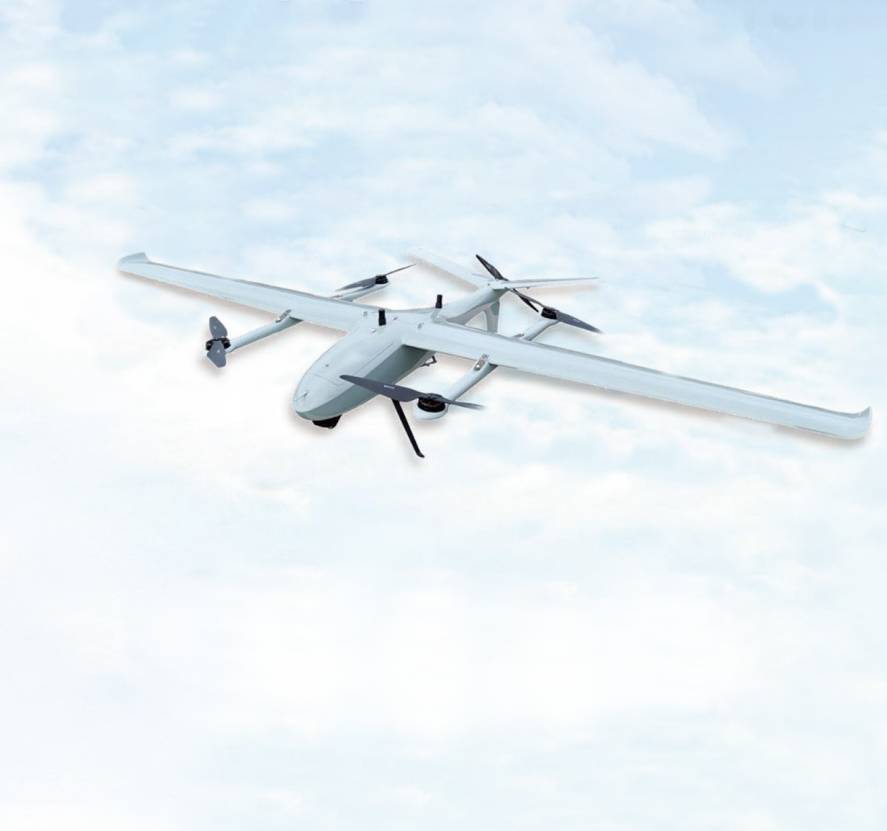

The drone industry has developed rapidly in recent years, with unmanned aerial vehicles now being used in surveying, inspection, mapping, agriculture, security, emergency response, and logistics. Among the different types of aircraft available, the VTOL fixed-wing drone has become an increasingly important solution for professional and industrial operations.
VTOL stands for Vertical Takeoff and Landing. A VTOL fixed-wing drone combines the vertical takeoff capability of a multirotor drone with the range, speed, and efficiency of a traditional fixed-wing aircraft. This hybrid design allows it to operate in locations without runways while covering much larger areas than most conventional multirotor drones.
What Is a VTOL Fixed-Wing Drone?
A VTOL fixed-wing drone is an unmanned aircraft capable of taking off and landing vertically. After takeoff, it transitions into forward flight and uses its wings to generate lift.
During vertical takeoff, multiple rotors lift the aircraft from the ground in a similar way to a quadcopter. Once the drone reaches a suitable altitude, it switches to fixed-wing flight. The wings then support the aircraft, while a forward-facing motor provides propulsion. Before landing, the drone transitions back into vertical flight and descends at the selected location.
This design eliminates the need for a runway, launching device, or parachute recovery system. It enables the drone to operate from small spaces, mountainous areas, ships, construction sites, and other locations where conventional fixed-wing aircraft may be difficult to deploy.
Advantages of VTOL Fixed-Wing Drones
Vertical Takeoff and Landing
One of the most important advantages of a VTOL fixed-wing drone is its ability to take off and land vertically. Conventional fixed-wing drones may require a runway, catapult launcher, or large open area.
A VTOL aircraft can be launched from a relatively small location. This makes deployment easier and reduces the risk of damage during takeoff and landing. It also allows the operator to reuse the aircraft quickly for repeated missions.
Longer Flight Time
Multirotor drones must continuously use their motors to remain in the air, which consumes a significant amount of energy. In fixed-wing flight, the wings generate lift as the aircraft moves forward, allowing it to use energy more efficiently.
As a result, VTOL fixed-wing drones can generally fly longer and cover greater distances than standard multirotor aircraft. This makes them suitable for large-area inspections, long-distance surveys, and extended monitoring missions.
Greater Coverage and Higher Speed
A VTOL fixed-wing drone can fly faster than many multirotor platforms. Its efficient aerodynamic design allows it to cover large areas within a shorter period.
This capability is particularly valuable for mapping large farms, inspecting pipelines, monitoring forests, and surveying construction projects. Businesses can collect the required data with fewer flights, helping reduce operational time and labor costs.
Flexible Payload Integration
Professional VTOL fixed-wing drones can carry different payloads according to mission requirements. Common payloads include high-resolution cameras, multispectral sensors, thermal imaging cameras, LiDAR systems, mapping equipment, and communication devices.
Some larger platforms can also transport cargo or carry specialized monitoring equipment. A modular payload design allows one aircraft to support multiple applications, improving equipment utilization and reducing the need to purchase separate drones for every task.
Applications of VTOL Fixed-Wing Drones
Surveying and Mapping
VTOL fixed-wing drones are widely used for topographic surveying, land mapping, construction monitoring, and geographic data collection. Their long flight time allows them to capture images over large areas efficiently.
When combined with RTK or PPK positioning technology, the collected data can be used to create accurate orthophotos, three-dimensional models, elevation maps, and point clouds.
Agriculture and Forestry
In agriculture, VTOL fixed-wing drones can monitor crop growth, identify water stress, detect pest damage, and collect multispectral imagery. Compared with manual field inspections, aerial monitoring provides a faster overview of large farms.
In forestry, these drones can be used for forest surveys, fire-risk monitoring, wildlife observation, and illegal logging detection. Their extended range makes them especially useful in remote areas.
Infrastructure Inspection
Pipelines, power lines, roads, railways, and coastlines may extend across hundreds of kilometers. Inspecting this infrastructure with ground teams can require considerable time and resources.
A VTOL fixed-wing drone can follow long inspection routes and collect visual or thermal data. Operators can then analyze the images to identify damaged components, vegetation interference, leaks, or other potential risks.
Emergency Response and Security
During natural disasters and emergency situations, VTOL drones can quickly survey affected areas and provide real-time aerial information. They can help locate blocked roads, assess flood damage, search for missing people, and support rescue planning.
Their ability to operate without a runway is especially valuable when local infrastructure has been damaged. VTOL drones can also support border patrol, coastal monitoring, and large-area security operations.
Technologies Supporting VTOL Drone Development
Modern VTOL fixed-wing drones use intelligent flight control systems to manage vertical takeoff, flight transition, route following, and automatic landing. The transition between multirotor and fixed-wing modes is one of the most important parts of the flight process.
GPS or GNSS positioning, obstacle detection, terrain-following technology, and communication systems help improve flight accuracy and safety. Autonomous mission planning software allows operators to define flight routes, altitude, speed, and data collection requirements before the aircraft takes off.
Advances in batteries, lightweight composite materials, motors, and aerodynamic design are also improving flight endurance and payload capacity. In the future, hybrid power and hydrogen energy systems may further extend operating range.
Current Challenges
Although VTOL fixed-wing drones offer significant advantages, they are more technically complex than standard multirotor drones. Their flight control systems must safely manage different flight modes and transitions.
Operators must also consider weather conditions, communication range, battery capacity, maintenance requirements, and aviation regulations. Beyond-visual-line-of-sight operations may require additional permits depending on local laws.
Professional training, regular inspections, reliable after-sales support, and appropriate mission planning are essential for safe and stable operation.
Future Development Prospects
The future of VTOL fixed-wing drones will focus on greater autonomy, longer endurance, increased payload capacity, and more intelligent data processing. Artificial intelligence will allow drones to recognize objects, analyze images, and adjust missions according to real-time conditions.
Multiple drones may eventually work together as coordinated fleets. Automated charging stations and remote fleet management platforms could support continuous operations with limited human intervention.
By combining runway-free operation with efficient long-range flight, VTOL fixed-wing drones provide a practical platform for large-scale professional missions. As technology and regulations continue to develop, they will play an increasingly important role in surveying, agriculture, infrastructure inspection, emergency response, security, and transportation.